Episode Transcript
[00:00:01] Speaker A: You're listening to the Doc Lounge Podcast. This is a place for candid conversations with the healthcare industry's top physicians, executives and thought leaders.
This podcast is made possible by Pacific Companies, your trusted advisor in physician recruitment.
Welcome back to the Doc Lounge Podcast. I'm your host, Stacey Doyle, Senior director of Marketing at Pacific Companies.
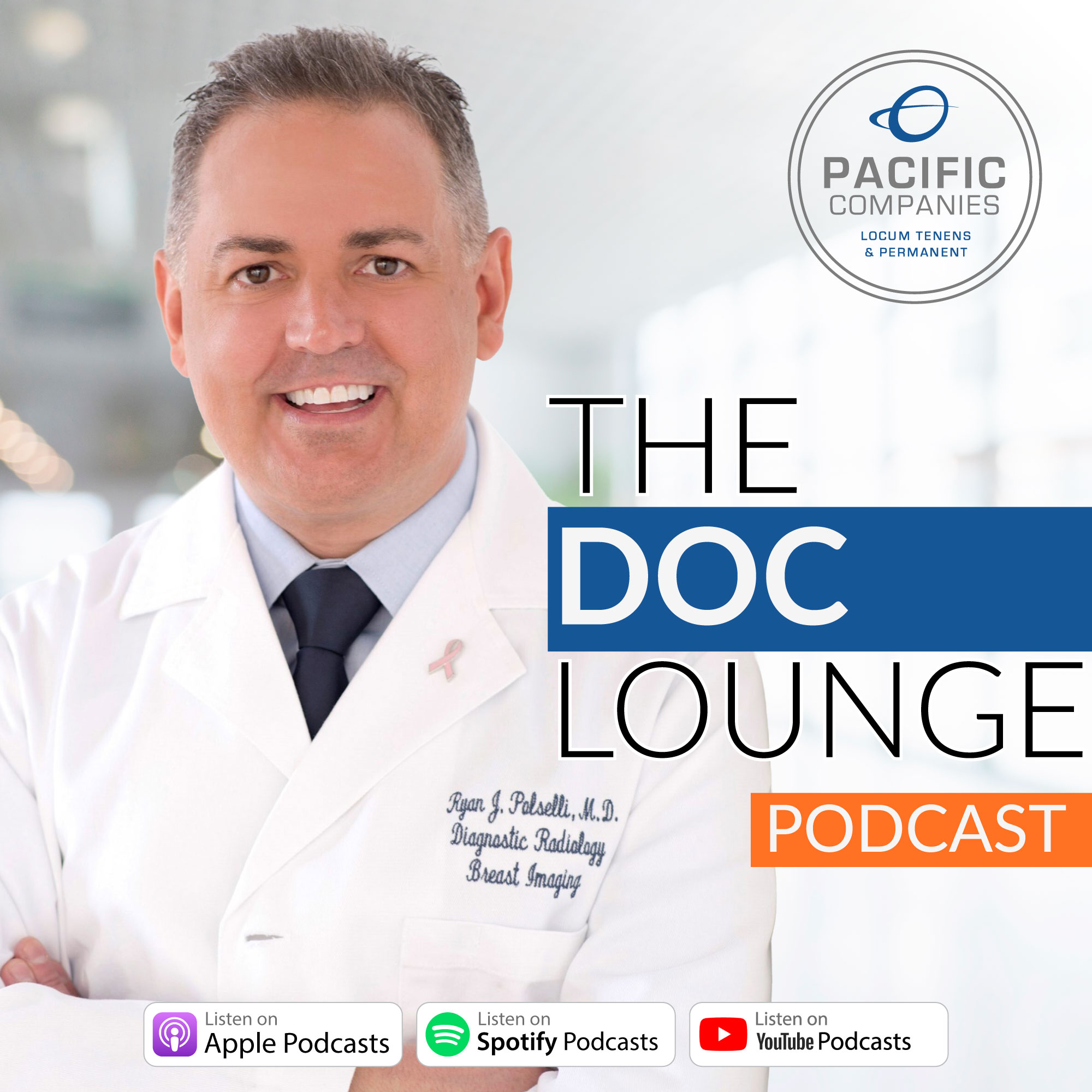
Today's guest has taken a truly unconventional path to rethinking how preventative care is delivered. Dr. Brian Pocelli is a fellowship trained breast radiologist from emory University, a US Navy veteran and the founder and CEO of MamaLink, one of the fastest growing mobile breast imaging companies in Florida. After spending time in the traditional hospital system, Dr. Pocelli set out to redesign breast cancer screening from the ground up. In just a few years, MamaLink has grown to a team of about 90 professionals, completed more than 55,000 screenings across multiple mobile units, and partnered with major employers like Walmart, Amazon, Costco and Royal Caribbean to bring imaging directly to where people live and work.
He's also developing a new technology like Rain, a real time AI navigation system designed to help women with dense breast tissue receive same day screening or ultrasound, along with a patient app that will provide lifetime access to imaging records and same day results.
His mission is simple but powerful, making preventative healthcare more convenient, more transparent, and ultimately more effective at catching cancer earlier. Such a powerful mission and we're so excited and honored to have you on the podcast today. Welcome, Dr. Poell.
[00:01:41] Speaker B: Yeah, thank you, Stacy. I'm happy to be here.
[00:01:45] Speaker C: Well, I gotta be honest with you, your career path is really unique. I was reading your background. So tell us, you went from like Navy nuclear power program to breast radiology to now a founder of a healthcare company.
[00:01:57] Speaker B: Yeah, yeah, it's, you know what, it's been all over the board.
And then a few years ago I said, the one thing I'm going to quit doing is predicting where I'm going to be. Because every time I say I'll be somewhere, it turns out not to be true. So.
But yeah, I've done a lot in the past. I think that's been actually kind of a blessing long term because it allows me to relate to more people, more different, you know, more areas in life, that kind of thing. So.
But yeah, even, even going into med school, you know, I said, oh well, one thing I would never do is radiology. That'd be boring. And then I ended up doing that and I said, well, the one thing I'll go, I'll never do is breast imaging. Looking at calcifications and Things all day that would be terrible. And then I ended up liking that the most. So, so here I am, you know, totally unpredicted. But, you know, it's been a fun path.
[00:02:48] Speaker C: Well, love that. Love to hear about, you know, how, how somebody kind of makes that transition. So tell us. I mean, obviously you walked away from the traditional hospital model to build mammalink so, you know, what were you seeing in the healthcare system that made you feel you needed to rebuild things in a different way?
[00:03:07] Speaker B: Yeah.
Frustrated really.
You know, I, it's kind of weird. You know, you start, you know, your medical career and, and, and you get further along and, and you keep waiting for this moment and to, to say, okay, well, now it all makes sense. Now I understand why we do what we do. And you know, I kind of kept hoping that that would happen year after year after year. And then eventually I kind of got to what I felt was like the end. And I looked around and I'm like, nope, it still doesn't really make sense. And so, you know, and I think I'm not the only one that, that said that. I think, you know, a lot of people, like I was listening to Sam Altman, you know, the CEO of, of OpenAI and, and ChatGPT the other day, and he's like, yeah, the, the funny thing about being an adult is, is you realize there are no adults. It kind of, you know, you think that there's this smart person in the room somewhere and then you get to the end and you're like, really? Really? It's. It's just us. And so it's kind of up to us to, to make the change. And so, you know, know, out of frustration and just not, you know, understanding why things were and saying, well, it could be better, I finally decided, you know, well, let's make it better.
Here we are.
[00:04:16] Speaker C: Well, and it's such an important mission. And I know that you've really talked about the idea, you know, that access to healthcare doesn't necessarily equal utilization.
So tell us a little bit about, I mean, to those patients that technically, you know, do have access and can get a screening.
[00:04:33] Speaker B: Right.
[00:04:33] Speaker C: What were you seeing? Why don't. People will get them still to this day.
[00:04:37] Speaker B: Yeah, yeah. I mean, that's the, that's the elephant in the room, the million dollar question.
You know, I think a lot of it has to do with, I mean, I know the reasons why, but the question. So which, you know, we know from, from research and studying this, that, that women that, that forego screening, mammograms it's, it's difficult, it's time consuming. It's, it's this whole long process, you know, and so it's just barriers and friction which reason that, that women don't get the screening mammogram. It's every year, lives are busy now, right. There's, you know, they're moms, you know, working women. And it's just one of those things that it's not front and center so it just gets pushed to the, to the back.
But the real question is, you know, why hasn't the, the medical establishment realized this yet and, and then said, you know, well, hey, why don't we actually, you know, do something about that instead of just, you know, doing the same thing over and over which we've been doing this whole time.
And so, yeah, that's the real question now.
[00:05:42] Speaker C: And I know, tell us a little bit about mammalink. I mean, obviously there's the mobile breast imaging component of it, which I'm assuming kind of really is a game changer when you're talking about convenience and, and being able to fit, fit, fit in this screening.
[00:05:58] Speaker B: Yeah, I mean, and the mobile is the most visible aspect of it. I, I kind of, you know, tell people like, well, you know, yes, we're a mobile company, but it's not a mobile company which defines us. We're really patient centric. And in order to be patient centric, well, the next step is, well, why don't we meet patients where they're going to get on the bus where they'll get screened. And so the mobile naturally follows. But essentially what, you know, the philosophy is is that if we could design a system from the ground up that would work starting with, you know, what patients would be willing to do if they were going to get a screening mammogram and then just, you know, work backwards. Okay. Well, we put it at their work where they can get out of work for 30 minutes, put a cup of coffee on there where they can have a cup of coffee and you know, just basically the wish list, like what would make a six star experience for a patient.
And then we kind of designed our systems around that, which is, you know, a little bit different than the medical facility which is, you know, well, you come and meet us on our time, you bring the script, you get your priors, you do everything and then when you're all done and ready, you can come see me.
[00:07:12] Speaker C: I love this patient centric approach, which I feel, I mean is a very radical shift from the way that healthcare is typically designed.
[00:07:20] Speaker B: Yeah.
[00:07:21] Speaker C: Now Tell us. I mean, I'm assuming another reason that you've heard from your research is that the anxiety around waiting for the result can be, can be a barrier.
[00:07:33] Speaker B: Yeah, yeah. And I think that does play a significant role.
Fear, you know, and then, and of course, you know, we don't help that very much either. If you, if you look at like the average time from a patient getting a screening mammogram until the time she gets the report, nationwide, on average it's between three to 10 days.
So, you know, you got 72 hours of waiting at a minimum usually.
And so, and you know, I think also too, that discourages coming back. When you go through that waiting and that experience, then the next time you have to get your mammogram, you've already had this experience where you're like, it wasn't really great. I was a little anxious for a few days. And so one of the things that, that has really turned out to be a more positive effect than I actually thought it would is that we're giving the results on the exact same day. So the patient comes in, they get their mammogram before they go to bed, they, they get texted and they can get a copy of their report. And the images, which of course, you know, some of the medical profession have questioned that are there, are patients ready for that kind of information, that kind of thing, but we've actually had no problems with it whatsoever. Occasionally a question arises and we deal with it, but overall, super positive. And I think it really sets patients up for a better experience the next year. They're not, as, you know, they're more like, oh, okay, it was great, I'll get on.
And I think that's what's going to make a big, huge difference in overall outcomes and things when it comes to terms of saving lives and things like that down the road.
[00:09:09] Speaker C: Well, I love that. I think a same day result is very similar to the trends that we're seeing in a lot of other industries. That has never really been applied. When you're thinking about healthcare and testing and screening, how that would be a real, a real game changer.
Tell us a little bit about. Obviously, you know, there's been studies and there's been, you know, a ton of people that have crunched the numbers. What, what is late, you know, late stage cancer detection, you know, what does that look like? I'm, I'm ensuring there's a hidden economic story there that it's. And it's not a favorable one.
[00:09:46] Speaker B: Yeah, absolutely. So, I mean, the economics, I Mean, you know, obviously, early detection is so much cheaper from an economic standpoint, so you're saving the healthcare system a ton. But also from the patient standpoint, the surgeries are less invasive. They don't have to have as much time off from work.
A lot of times you can avoid chemotherapy in the whole nine yards. So I think that's another real benefit for taking the patient centric model and really pursuing it. So, for example, um, you know, when I see, you know, a mammogram that has breast cancer or something, say it's calcifications, I know it's early stage, stage zero, maybe stage one or something, you know, I don't even get upset. I know it sounds crazy, right, because it's cancer, you know, but I'm actually like, oh, great, we found it. This is. The patient's going to be fine. I'll talk to him in 10 years. You know, so that's one story.
The other one is, oh, crap, it's in lymph nodes. I see them. And then, and then, I mean, it's a totally different disease. And I actually, I actually think that we don't do us, we don't do any justice to the whole system by not differentiating breast cancer in, you know, it's like category five hurricane, Category one. Everybody sees here's hurricane. They think it's the same thing, completely different things. A category five is just terribly destructive. Category one, you know, you just, it's like a, you know, a little windstorm.
And the same thing is true with breast cancer. So, you know, I really think it would be useful if we had different terms for it. But in any event, yeah, two different, two completely different stories economically.
Time off from work, you know, the whole nine yards.
[00:11:24] Speaker C: I think that's a very important message to get out there. And I think, again, why the annual screening is such a big deal and why it can really help, you know, kind of change. Change, you know, the needle with health outcomes and then also financial outcomes. And the reason I was bringing that up is I wanted to hear from a payer standpoint, you know, like for insurers where they are with this. I see that you're partnering a lot with a lot of major employers directly, which huge. I mean, you're, you're working with Walmart and Amazon. So tell us a little bit about that.
[00:12:00] Speaker B: Yeah, I think, I think people are, you know, insurance companies as well for, you know, as much bad rap as they get, you know, and some of it deserved a lot. In a lot of ways, they're Trying and it is changing slowly. And I've even seen a change in the way that they, they treat us since we first came on and where we now and the employer groups as well. I think this, people have, you know, started to see that early detection and prevention, that's the key and it's really in their consciousness and they're making decisions to, to, to, you know, to, to treat this and to do the right thing.
And you know, like, we're getting companies that, you know, they, they, they want to boost their HR benefits for their employees, be seen as actually caring for them kind of thing. And so I, it's a, I think that's one of the positive things that's, that's happening in health care is that especially with, related to the screenings, even in colon, like other screenings to colon cancer, lung cancer, you're seeing a lot bigger emphasis on it. I think it's really going to pay off.
[00:13:07] Speaker C: I think it is very, you know, worthy of like almost a new trend. And I know you've talked about this before, you know, the future of decentralized health care. So tell us a little bit about kind of your vision there and where you think things are headed.
[00:13:21] Speaker B: Yeah, you know, it's kind of like retail medicine is the term that I've heard some people use and I think it's very empowering. When patients feel like everything is in their control, all of a sudden it's not as bad, but it's, you know, when you tie their hands and they have no power. And you know, that same thing with physicians too. Right. So when we have the opportunity to, you know, kind of, you know, forge our own path and actually treat patients and we're not being subject to all these rules and regulations that make it diffic.
We're happier as well. So I think it's a, a positive overall trend and I think it's really getting patients more involved in their healthcare because, you know, they understand that, you know, you know, they have, they have a pos, you know, the ability to do whatever they want with it.
And I think it's increasing overall compliance, the likelihood that people will come back.
So, yeah, I think that's, I think that's one of the, the real positive things that I'm, that I'm seeing
[00:14:22] Speaker C: now. Tell us. Let's shift gears a little bit. You have also developed rain, so that's a real time AI navigation for dense breast tissue, which I know that is somebody that, that those patients typically will need to get screened more often. Tell us a little bit about that.
[00:14:38] Speaker B: Yeah. So a dense breast tissue, it's, it's a risk factor for cancer in and of itself. The more active, you know, dense tissue that you have, the higher the risk.
They finally come out and officially made that an official statement. But then also too, you know, with dense breast tissue, it's very, it's much more difficult to see through the mammogram. So cancer can hide, you know, whereas a purely fatty breast with all that, without all that dense fibro glandular breast tissue might see, you know, a cancer at 5 millimeters, 4 millimeters, even something real small.
And then dense breast tissue, it's going to, it's going to take some time to grow before you're going to see it. So there's really been an emphasis on, on, on. On ultrasound to supplement the, the mammography. The problem is, you know, all the way the system is designed is it basically makes it very difficult for the patient. So a lot of them, if the doctor doesn't write the script originally, and even if they do, a lot of the imaging facilities are not set up in a way such that they can get the test immediately done at the same time as their mammogram to come back, or they have to get a script another day off, just another test, when really, I mean, ideally it should just be done at the exact same time. So, you know, there's a lot of hype out there with AI and there's, you know, and, and, and they're using it predominantly in, in, in radiology right now as a, as a means of detection. And sure, we have that, but the other benefit of AI is all this stuff that if you really look at, well, how can this actually have a positive effect for the patients beyond just, okay, well, maybe the 11% more detection of breast cancer, which is, you know, not, not small and not something to be, to be disregarded, but at the same time, you know, you know, well, how about in terms of saving patients time? How about in terms of making their process easier? So that's what we've done. We've adopted it so that we can use it in our workflow and we've done some, some medical legal maneuvering in terms of being able to have somebody that's with us write the scripts and that type of thing. So it's, so far it's worked out really well. Patients love it.
I think it makes them feel good. They've got their coverage, they don't have to worry about it. They come back next year.
[00:16:52] Speaker C: That sounds incredible. And I know that you Have a patient app, tell us a little bit about that, how that works and what feedback from your patients have been.
[00:17:03] Speaker B: Yeah, so. Well, this thing has been in development forever. It's just like every other IT project. It keeps getting pushed back, pushback. But the real cool thing about this is one of the things that, that, that I've struggled with the whole time and really the whole field does, is patient priors.
You wouldn't believe how many patients I can't remember where I had my mammogram two years ago. And you know, and so now, you know, maybe they have cysts and you could avoid the ultrasound and move on, but you've got to go and get additional testing just because you don't have the priors. And so it's a huge issue, really delays the whole process. And it's kind of a mess, to be quite honest with you.
Of the things that we're doing is, is we're giving patients lifetime access to their, their, you know, and, and so everybody has their phone. They're not going anywhere without it. And we're going to live on the phone. And so for the rest of their lives, you know what, I can't remember, but I remember it's on the phone and they can hit the button and they're their priors. And, you know, we can, we can ship them wherever they need if they go somewhere else down the road. But I think that's a real nice advantage.
And then, and then one of the things I think is really cool is reminders.
So rather than have a traditional reminder system, what we're going to do with the app is we're going to have a little, little meter like a thermometer. And so once you've gone past your 12 months or whatever, you know, you might see, oh, it went up a little bit or now it's a little yellow. Right. You're in that period where, oh, I need to start getting my mammogram again.
And then if, you know, you're beyond two years now, it's going to show red and basically try to correlate it. And we'll eventually do this with AI too, with the actual risk. So you can see your risk, your lifetime risk is of, you know, early mortality or something like that is going up.
And I think that'll be a real, real nice feedback mechanism instead of just, oh, your mammograms do, you know, because you can see it. And I'm interested in how that will play out in terms of, you know, decreasing mortality and stuff. Long term
[00:19:09] Speaker C: love that I'm sure patients will love that too. And I think it just makes sense to have it integrated to where everybody is on all day and looking with their phones now. Tell us. We've heard a lot about how AI is going to be integrated and kind of disrupting radiology.
What are you seeing? Where do you think that that will be going in the future?
[00:19:32] Speaker B: Just as, as, you know, I mean, it's moving pretty quick right now. It's not there I could tell you from, you know, and I'm using the most advanced or one of at least arguably, AI breast cancer detection mechanisms, and it is still not as good as the human eye.
Is it helpful? Absolutely, 100%, because your eye can't be everywhere all the time and it's always extra. It's always nice to have a second set of eyes, so to speak, but it's not, it's not mainstream yet.
I think the bottom line is that it's much more, you know, the large language models. It's easier to categorize words and to recognize patterns in words and speech than it is visuospatial. And so it takes a lot more learning and a lot more training, I think, to get there.
Will it be better than a human at some point? I mean, it's hard to say that it won't.
I mean, you know, with the way that it's going, I mean, we, I mean, we're just, just in this and, you know, we're already seeing it, you know, how powerful it can be, so. But I think that's a positive thing. I mean, I think that's a hugely positive thing. I love to see the day when it's better than the human eye.
You know, does that cause a little bit of concern in terms of job, you know, for, for the first editions in radiology, particularly?
Job security down the road. Yeah. But I mean, it's kind of doing that to everybody too, though, so we'll see where it goes, you know, I do think, though.
Yeah, exactly. Right. And even for us, you know, it's like, you know, you, you sometimes you're like, you know, I was a little distracted today. I hope I didn't, you know, that kind of thing. Hope I didn't miss anything. I mean, that's human nature, so. Especially if you care.
So, yeah, I mean, that will be nice. But I really think the, you know, what I'm interested in, AI is for the ability to kind of predict and maybe more of a psychological aspect to it with humans and stuff. And so I'm interested in the qualitative data as well as the quantitative data.
And that's what I want to eventually kind of put it all together to make the best model that works.
[00:21:49] Speaker C: Love that. And I feel like you're the perfect person to do that with, obviously, all of the innovation that you've done within this space.
Doctor, tell us a little bit about, you know, if a patient or an employer or healthcare, you know, any insurers listening, where can they go to learn more about mamolink? Where are you guys operating? Tell us more there.
[00:22:13] Speaker B: Right now we're in Florida. You know, we should, you know, we'll be in multiple states at some point here. The quicker the better for me. But, you know, it's a tough process, so. But mamolink.com M A MMO L I N K.com they can, you know, that's probably the best way because there's a little click here to learn more kind of thing and it'll kind of put you through the funnel and you'll get in contact with one of us. But yeah, you know, all over, really, social media, whatever.
LinkedIn. Ryan Palli.
[00:22:46] Speaker A: Perfect.
[00:22:46] Speaker C: Perfect. Well, I'm sure you'll have a lot of interest after, you know, after this airs, so definitely want to make sure, you know, everyone can go to mamolink.com learn more if you're a patient, a provider or an employer, ensure any of the above.
And I really appreciate, you know, your mission and making, you know, women's health more accessible and really leading from an innovation standpoint. And it was great to have you on the Doc Lounge podcast today.
[00:23:14] Speaker B: Thank you so much, Stacy. I appreciate that. It's been nice.
[00:23:19] Speaker C: Thank you.