Episode Transcript
[00:00:01] Speaker A: You're listening to the Doc Lounge Podcast. This is a place for candid conversations with the healthcare industry's top physicians, executives and thought leaders.
This podcast is made possible by Pacific Companies, your trusted advisor in physician recruitment.
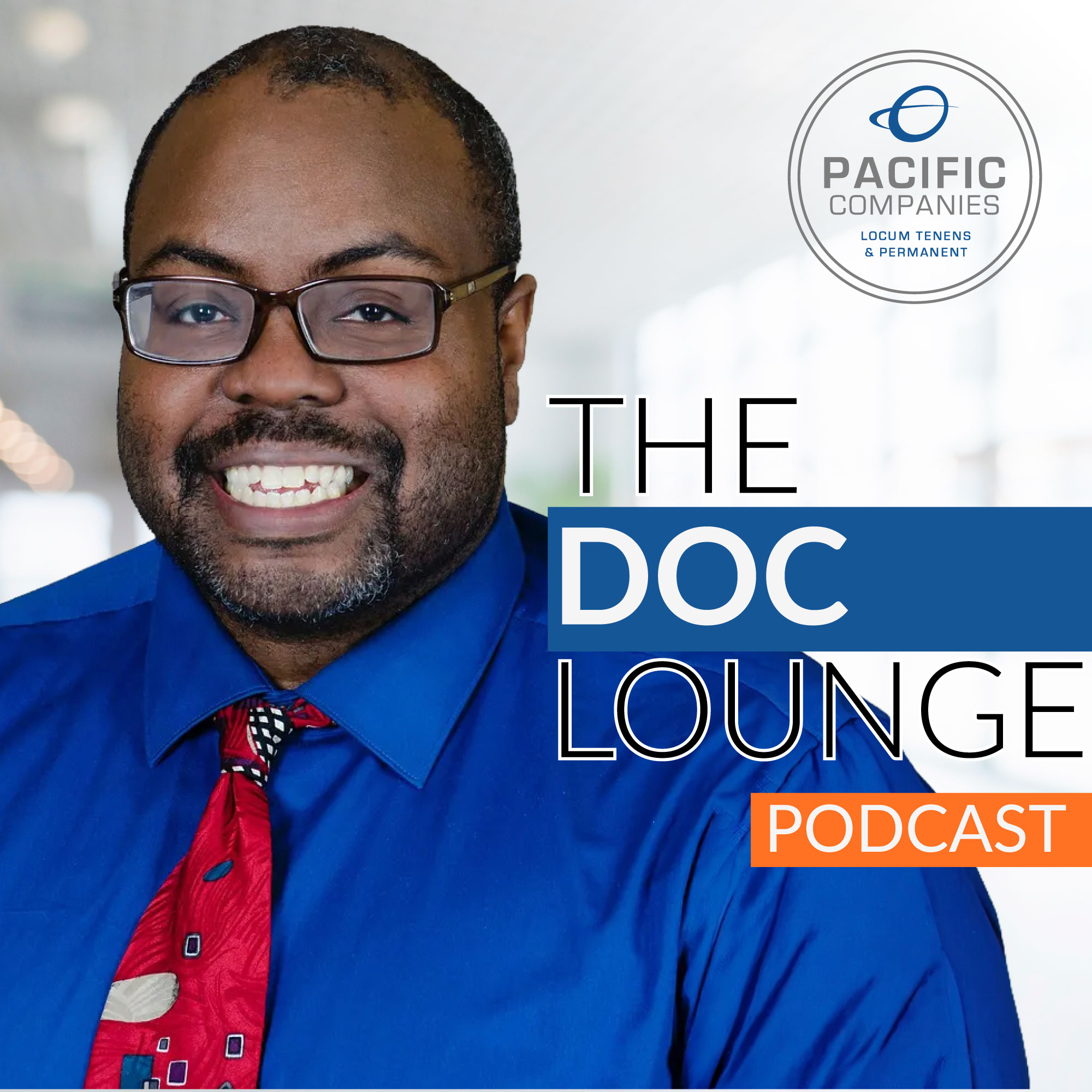
[00:00:20] Speaker B: Today on the Doc Lounge Podcast, I'm joined by Dr. Eugene Manley Jr. A biomedical scientist turned social impact leader, leader and the founder and CEO of the STEM and Cancer Health Equity Foundation. With more than 20 years of experience across engineering, molecular and cell biology, nonprofit leadership, and workforce development, Dr. Manley's work is deeply shaped by lived experience growing up first generation, witnessing inequities in care, and personally experience medical racism. Those moments fueled his mission to build healthcare systems where equity is measurable and no patient's voice is overlapped.
Through Scheq, he brings together payers, pharma and health systems to close gaps in cancer screening, biomarker testing, clinical trial access, and survivorship, particularly for Medicaid and historically marginalized communities. Today, we'll talk about making equity actionable, leading with both data and empathy, and why meaningful change starts with accountability and follow through.
So we're very excited to have Dr. Manley on today to talk about this important topic. So welcome. So glad you're on the Jock Lounge podcast.
[00:01:31] Speaker C: Thank you so much for having me on, Stacy. It's a pleasure to be here and you do such a great job with your show.
[00:01:38] Speaker B: Thank you. Thank you. Well, we're really excited to have you, and I really want to start because I know that your journey into health equity is really, you know, it's really personal. So can you share a moment or experience that really fundamentally changed how you were thinking about healthcare systems and health equity?
[00:02:01] Speaker C: I'll give you two things. Well, technically three. I'll combine them. So as a child, I grew up. I was a chronic asthmatic. My father was a chronic smoker. But I grew up as a chronic asthmatic, I think from the exposure.
But because of that, I also had anaphylactic allergies because there's this link between asthma and allergies. And I was in the hospital 20 to 30 times a year until I. From when I was 5, until I was about 10. It was just my acid would just trigger, like, crazy seasonal stuff, grass in particular.
And you just never knew when it was going to happen. And this is before we really had a great understanding of anaphylactic allergies. So it's a miracle that I even survived.
But as a kid, I didn't have as much trouble with care as my family did because, you know, we grew up Poor.
But I just saw how specifically in later ages how my mother got treated in the healthcare system, how often when she had hospitalization, specifically the night staff, the nurses would be rude, doctors would be dismissive, or they would try to give a readout of an appointment. Oh, well, it's in my trouble. One, she doesn't have a phone, she doesn't have a printer. And then if you give a printout, if you tell them to read instructions, but you're action items are on page five, no one's going to get through the four pages of medical jargon. It made it clear that making stuff translatable and understandable for patients were important. And then that sort of tied into my work in lung cancer. And initially we weren't doing disparities in lung cancer. But then as I went and worked in nonprofit spaces, I saw these massive disparities where black patients weren't getting biomarker testing, weren't getting offered trials, weren't getting access to all the testing they should be entitled to. So it sort of became a call to how do we start making this information more digestible and understandable to the public and helping them be able to navigate and advocate for care they're entitled to.
[00:04:05] Speaker B: I love that. And such obviously an important and big mission that you're taking on. I know you often talk about, okay, we gotta make equity measurable, not just an aspiration.
So tell us a little bit, what are some of these practical ways that healthcare organizations can kind of move from just what they're saying to real kind of data driven action.
[00:04:30] Speaker C: So, you know, often we talk in the abstract about health equity, like we want to do something, and then when it comes to implementation, you're afraid.
And the first thing you have to understand is health equity, at least by my definition, is intentionality.
You have to intentionally address a disparity or inequity for one or more groups so that they have the same outcome for whatever the baseline or majority population is. So that does not mean it's only just black or Hispanic. It could be rural, it could be urban, it could be suburban, it be, could it could be women with lung cancer. So there are many disparate groups, but then you have to design a specific intervention for that group that addresses in inequity so you can look and see what you've made progress on. If you've not targeted it towards a group with the disparity, then you don't have health equity. And so some examples are, are you increasing awareness about lung cancer screening in underserved communities. So that might entail working with the federally qualified health center that has a black and Hispanic population. If you are engaging with them, are your efforts leading to more people getting screened? Are they getting diagnosed early? Are they getting biomarker testing? Those are things you can measure downstream based on the intervention you have put in.
If you think, for example, maybe breast cancer, let's say you want to develop an algorithm to assess breast cancer risk in women with dense breast.
Okay, if you just say we have an algorithm, we're going to test it on everyone, inevitably your target population is probably going to be a suburban, non diverse population and you can't use that as your training set and test set because then it's invalid while it could work. But then you have to think more big picture, what is the disparity in breast cancer? And you have to do due diligence to understand that black women tend to have dense breasts and that is why they tend to have increased breast cancer risk. So if you don't understand that fundamental piece, you cannot develop an intervention.
[00:07:00] Speaker B: That's fascinating and I think obviously that is very, what you just said are very action oriented things that systems could do to make sure that they're making things equitable.
And I know you talked about earlier about biomarker testing gaps and that really does continue to be a major driver for unequal cancer outcomes. So tell us a little bit more there. What are the biggest barriers you're seeing a day and where can systems really kind of make faster progress?
[00:07:32] Speaker C: So we'll look at this from two lenses.
We know we have screening now for colon cancer, prostate cancer, breast cancer and lung cancer.
However, lung cancer is the leading cause of cancer death in the US and worldwide. However, it gets way less funding and attention and colon, breast and prostate altogether. And for some reason, well, there's this massive stigma around lung cancer.
You know, if you think about the anti smoking campaigns of the 80s, they were really great about, you know, having the people coughing and saying, you know, you get this, then you going to get lung cancer. And while yes, smoking is about 60 to 70% of the risk of lung cancer, there are other risk factors that include indoor cooking, air pollution, you know, firefighters of just that, exposure from all, you know, in the field, forest fires, you know, just the particulate matter.
And so. And those aren't even part of the lung cancer screening guidelines. The lung cancer screening guidelines say you must have a history of smoking or have quit within the last 15 years.
That's the lung cancer screening guidelines. Now the way you can increase Screening for these other at risk populations is you need a group that's proactive enough to write that in the screening parameter at that hospital and then it can be incorporated. And once you do that, you actually are able to capture many more people and get them screened. And the key ideal for lung cancer is the earlier you get them screened, then you're more likely to not have to do invasive surgery to remove stuff. And you may be able to just do chemotherapy and radiation. That's in a perfect world.
But for those other cancers, breast, colon and prostate, they are more robust. There's more people are more aware of the screening and it's just still making sure they're aware of the benefits of it. Because there's still stigma around prostate cancer, people don't want to talk about it.
And sometimes when you're dealing with underserved families, there's a concern of, I don't want to bother people, I don't want to be a burden. And so sometimes you're worried about, are you going to lose your job? Can you pay insurance?
Because there's a massive other side of cancer care that is a lot of people go broke within a year of cancer therapy or cancer treatment because the medications are so expensive.
[00:10:08] Speaker B: So that, that leads me, when you're just talking, so you were talking about how expensive the medicines can be in the therapies. And I know that your work has really crossed from, you know, payers to pharma to health systems. So tell us about, you know, from your perspective. Where do the cross sector partnerships break down most often and what separates collaboration that works and installing where we could make more progress here.
[00:10:40] Speaker C: I think there needs to be universal communication across from the patients to the hospital systems, to the clinicians, to the surgeons, to the researchers, to the payers, to government. You know, typically the biggest block is the payer because we have now about 10 targeted therapies for lung cancer. But most people still only get one to three biomarkers tested, as opposed to the whole suite of 10. So you still have massive gaps in who gets all of the testing. And it's still often predicated by money and insurance.
And then insurance would not approve the other tests. And so we need to have more universal policies that require that all testing that people are eligible should be done at the beginning. Because if you do it early and there's a likely therapy, then you can get them on treatment early, maybe stop that tumor growth and extend life. But the longer you wait or delay, the worse it gets. And so we need to get payers to be more willing to make policies that work for these groups. But we also need to do something about the cost of prescriptions because that's the other thing that really makes people go broke. And then on the transition from the hospital to the patient, we need to make sure those hospital teams, the community engagement teams, are reflective of the communities that they serve, that they have cultural competency, that they understand that specifically, not so much the well off people, but the underserved and poor are probably working two, three jobs. So they may not be able to come at this specific time. So if you don't give extended hours or weekend hours, how are they supposed to get there? Or if they are dependent on medical transport, especially if you're on Medicaid, on the one hand that looks great on paper, but then often when you're trying to get a ride, there's not one specific vendor or server. And so what happens is you could be have deal with any one, get one taxi and then they call you the day before, say they'll show up, then the next morning they don't show up. And then how are you supposed to get to an appointment that you've already had paid for? And then if you don't show up, you get labeled non compliant. And then sometimes when you get transferred back, they don't show up and then you're stuck waiting to get home. You and these things don't go into care delivery. So we have to really more holistically understand the whole patient experience and not just say, well, they're non compliant because they didn't show up at this time. Like there's often other factors that play that aren't necessarily in the medical charge, but they should be.
[00:13:30] Speaker B: Great point. And that leads to. I know before you know this podcast, you and I were chatting and you had really some personal experience about being a patient and experiencing some of this racism and inequity. So I wanted you to share a little bit more about that and then through that, what patients can do to empower themselves and to make sure that they are being treated fairly.
[00:13:58] Speaker C: Okay, so when we think of this in a simple level, the situation that I had is that I had a slip and fall fracture of my ankle and the fracture sort of healed, but there was enough extensive damage in the foot that I needed to have reconstructive surgery. And so the surgeon knew I had a biomechanics background. So the surgeon was not the issue.
We went to hospital, they had scheduled the surgery for March 6th.
All I asked him was that I be placed in skilled nursing because the surgery is non weight bearing. For six weeks you're in a cast and if you have this kind of surgery you're either using a walker or a scooter. But that means you only have use of one leg that you're hopping with and then the two hands are on handlebars. So you can't cook, you can't clean, you can't really open refrigerators and the pain is unbearable. So he agreed and he said, well, let's do the surgery and then we'll get you a skilled nursing assessment by PT at the hospital, which he didn't think would be a problem.
However, everything went downhill after we got in the hospital.
So surgery went off, no issues.
We got a late start. We started around 4pm on a Thursday evening. We finished around 9.20pm it was just a lot more in depth stuff that needed to be done. So it was late Thursday night. He said, well, we're not going to get a skilled nursing placement on Friday. So he said we'll just have PT come in over the weekend and then we'll start the paperwork on Monday.
And I was okay with that and I knew we needed to do X rays.
However, everything went downhill after that point.
And so that Saturday morning, PT came in the room around 9:30 in the morning, tried to force me to use this standing walker and I told them how much pain is this? Because I still had just had the surgery. So I'm supposed to stand on this walker and keep this one leg bent while hopping on the other leg, which I've already had an ACL reconstruction and flat feet. And you're saying oh, and you're, well you have to do this. And I'm sitting there like it's a non weight bearing thing. And that is in the instruction. So why are you trying to force me to stand? So I had to do this and it was ungodly unbearable pain. And I articulated this and what ended up being written in my medical chart was that paper, patient has no pain and can ambulate.
That's what she wrote in the chart. And I didn't read this until three and a half weeks later.
So from that point everything that was done in the hospital went downhill because they intentionally misrepresented one the amount of pain I had. And there's no way I can have no pain when I'm getting Percocets every four to six hours and I'm in a cast.
And so, and so they're saying one thing to my face but lying in my Records. Now, I had a medical proxy, but my proxy was located in Florida, which meant, you know, if your proxy is not at the hospital in real time, you're still at the whim of the hospital, which I learned the hard way. So if you can answer the day, time and place where you are, they will consider your AO times three, which is alert and oriented. So while I could answer those questions, I clearly was not alert. But because of that, they were rushing in, people saying, well, he agreed to this. I said, I didn't say any of this. So they didn't even call my proxy because I was apparently alert. So they were just making up stuff in my chart. That Saturday evening at 6:30pm one of the nurses had come in, had tried to give me a discharge notice because anytime you have a procedure, they will try to get you out of the hospital fast as possible.
And it said you have to appeal to insurance by noon the next day or if you say you'll be responsible for anything in the hospital. And I said, one, I'm in no condition, Literally, I'm in no condition to read this. I'm barely functioning. And that's when I called my proxy and I took a picture of that. And then my proxy called and yelled a nurse. Like, this is illegal. This is irresponsible. Like he just had surgery. He's not had follow up with the surgeon yet. He's not seen a caseworker or social workers. Why are you trying to give him a discharge notice? And then on that paper they hit it. They had wrote, 9:30am was when they gave it to me, but it was actually really 6:30pm so if I hadn't argued on that, then what would have gone in the medical records is that it was given at 9:30 and they would have been legally fined because by law you have to give a person the notice 24 hours in advance. So you, you write one thing, but you give it to me at another time.
And then that following Monday, the hospitalist who was supposedly in charge of the hospital stay because the surgeon didn't have direct admitting privileges, she comes asking about my ability to pay for skilled nursing, which made no sense to me at all because she was not the one who did my surgery. And then I think, and I finally got so frustrated because I could tell clearly they were not listening to anything I said. They ignored everything I said about my state, how I live, how I can't work and do anything from home alone.
And she wrote, when I asked, this patient cried. I said, you missed the whole part of you not listening to anything else I said. And you then just completely disregarded what the surgeon has said. Now, what I didn't know was behind the scenes, the surgeon was still trying to get PT to change their assessment because apparently PT and OT had said that patient has no pain and can ambulate. But like I said, I'm on painkillers every five days.
And then he lost his peer to peer on day five because, well, insurance is like, why didn't you appeal sooner? He said, well, I tried for five days to get PT to answer me and PT would not answer him. So he's arguing with the hospital about why they aren't doing what he recommended.
So they somehow decided that they know more than the surgeon and the patient with the biomechanics background. And all this probably is predicated on the fact that I was on Medicaid at the time. And so, you know, I launched a nonprofit, so I'm on Medicaid. So they assume black, uneducated, don't know anything. So we're just going to run him through the ringer. And so they did this. And then another day, I think that Tuesday there was a patient in the other bed and somehow the staff hit my foot four times in a half hour period. And that's the only time I yelled at them because I was, I'm like, can you just stop hitting my damn leg? Sorry for the language. Yeah, but I'm incensed. You're not listening, you're making up stuff. And then they still are lying to me. And then at this point, my liver numbers are going out of whack because the first blood thinner was just killing my system. So we ended up spending two more days doing assessments of that and then we switched to blood thinner.
Everything came down now because they didn't want to listen to the surgeon and they were so discernment. They were doing everything right. They rushed to get me out. They tried to say, well, what if we get you home nursing? So I said, begrudgingly, I agreed.
And then in this time, the surgeon tried to do his appeal. It was denied.
And then as soon as that was on pt, hurry up and discharge, we said, get me out the hospital.
So now, mind you, I didn't know any of this was in my medical records because I did not even bother trying to read it until three and a half weeks later.
But when they gave me a scooter on the last day and think they did something right when they should have gave me the scooter at the beginning, they said, oh, well, he could walk to the hallway so he can do stuff independently.
Now, mind you, I only walked to the hallway because there was someone right at the side of me in the hospital.
So I was just like, you're making up these projections of what you think I could do, considering that it's a non weight bearing surgery. So every step was just ungodly painful.
And I just never disrespected, ignored, mistreated. And I think about all the stuff my mother had went through when she was in the hospitals. And then you think of what happened to other black patients who this happens to a lot that we don't often talk about. You know, it wasn't just Serena and her embolism during pregnancy. There's so many issues with black women in childbirth and how they often. We have such high mortality rates. You have Venus Williams with her fibroids. You have me, who has a PhD in biomechanics and a surgeon in agreement. But the hospital deciding they're gonna make up their own standard of care. And then. But just I think of how many other poor, underserved, marginalized patients go through that hospital and how many are getting pushed out early who don't even know why, who are getting readmissions, who are having falls.
And like, on my chart they said, oh, patient can go and walk. And I'm sitting here like. And the next day I had to try to go get prescriptions because Walgreens won't do mail order if you're on Medicaid. And so they wouldn't do mail order. So I had to try to go to the Walgreens. I don't think I made it more than 50ft. And I failed. And I'm like, nope, we're not doing this. So I had to wait for a friend to show up.
But because of the back and forth of the hospital system, what they wrote, I only was approved for four days of home health aid, which we would not even got approved if the surgeon hadn't argued for that. So while the hospital said one thing, they were doing another.
So moral of the story is, for patients that are going in for surgery, there are some key things that you need to do. One, you need to know what your procedure is, what's the expected outcomes, how long it's going to take.
Two, you need to have a medical proxy that can be with you in the hospital in real time so that once that surgery is done and you're still sedated, any questions they ask goes to your proxy because you don't want them to say you're a learning oriented times three. And then they just do all this stuff. It's like, well, you agree to it. No, have that proxy argue and tell them they can't ask you anything. Go through your proxy, make sure your proxy reads your records in real time so they don't try to make up stuff that's not clearly not true. Like there's no way with a six week non weight bearing surgery that I can have no pain. Just that's impossible.
Three, you want to make sure that you know, you, if you have Transit, like especially if you're on Medicaid, Medicare, you have to make sure you get that transit set up before you go into surgery, which I didn't learn until after the fact. And then even when you have it, you have to call these companies, the car companies, sometimes two days in advance. They'll confirm you have an appointment a day before and then even the day of your appointment they may not show up. And it's not one company, there's a whole bunch in the pool. So you still have to pretty much tell them you want to be picked up two hours early in case they're late, and then you have to wait for them to pick you back up. And I've had instances where they didn't show up for the pickup or to drop me back off. And so that's something. Even though it's a service, it's still when you don't have means of transport and you can't take subway. It's quite the challenge. And then when you are facing these challenges in the system, I want people to be able to print their records, everything that happened in that hospital so you can read everything.
When you have hospital staff that have done nothing, make sure you contact Patient advocacy.
I called Patient Advocacy twice after I got home. They never called me back. The only time they called me back was when the next thing you do, when you want to file complaints, file it with hospital leadership, the CEO, the chief risk manager, whoever was responsible in your care team, and then Patient advocacy and send it certified mail. Because if you send a certified mail, they can't act like they didn't receive it.
Now in my case, they sent me some dismissive letters. They called me Mr. Manley and not Dr. Manley and then just said, well, we gave you a scooter. I said, yeah, after all the other stuff you lied and misrepresented and like if I had known three and a half weeks prior that you were lying about my pain, I would have never left the hospital. Because that impacted the care I got on the back end.
So those are things you have and then what you file with, not just them. You can file complaints with insurance, the Joint Commission for Hospital Accreditation. If it's a Joint commission accredited hospital, you file with Centers for Medicaid Services for Medicaid, Medicare insurance fraud. You can file in New York, specifically, physical therapist, occupational therapist. You file with the Office of Professional Discipline or office Department of Education. But they certify a physical therapist, occupational therapist because that investigation is separate than what the hospital will and will not cover up. So you can't protect those that are licensed if they have a standard duty of what they're supposed to do. And then if you really want to be the person, you can connect with your local representatives, try to find a lawyer.
I tried that last year and that just.
They tend to not want to take malpractice cases if it's not the surgeon.
They love going after surgeons, but the surgeon and his residents did everything right. It was the rest of the hospital staff that was complicit. But just say keep my whole thing, keep track of everything, record everything, write report, and then you can use your voice, get on social media, get on podcast. That wasn't solely the reason we being on your show, but I'm an educator. So how do I help you make sure when you go in these places you are set or at least prepared to get better care. And they can't just try to get one over on you. You know, just the people are trying to reach out. You know, we have the nonprofit check scheq.org I also just launched the consulting firm innovation for impact. So innovation for F O R impact llc.com it's an extension of broadly the work I do in strategy, program development, grant writing and public speaking. And then you can find us on socials of Eugene Manley Jr. On LinkedIn and also on Facebook, Instagram. You can find sgmmcheq, which is the org. And I hope this was informative to your audience and hopefully at least specifically the patients will have some takeaways to think about how to interact in the healthcare system, how to protect themselves when they have surgery.
[00:28:52] Speaker B: Thank you so much, Dr. Manley. Appreciate your time.
[00:28:55] Speaker C: Thank you so much for having me on. Have a great day.
[00:28:58] Speaker A: Thank you to all of our listeners. If you would like to be notified when new episodes air, make sure to hit that subscribe button.
And a big thank you to Pacific companies. Without you guys, this podcast would not be possible.
If you would like to be a guest, Please go to www.pacificcompanies.com thank you.