Episode Transcript
[00:00:01] Speaker A: You're listening to the Doc Lounge Podcast. This is a place for candid conversations with the healthcare industry's top physicians, executives and thought leaders.
This podcast is made possible by Pacific Companies, your trusted advisor in physician recruitment.
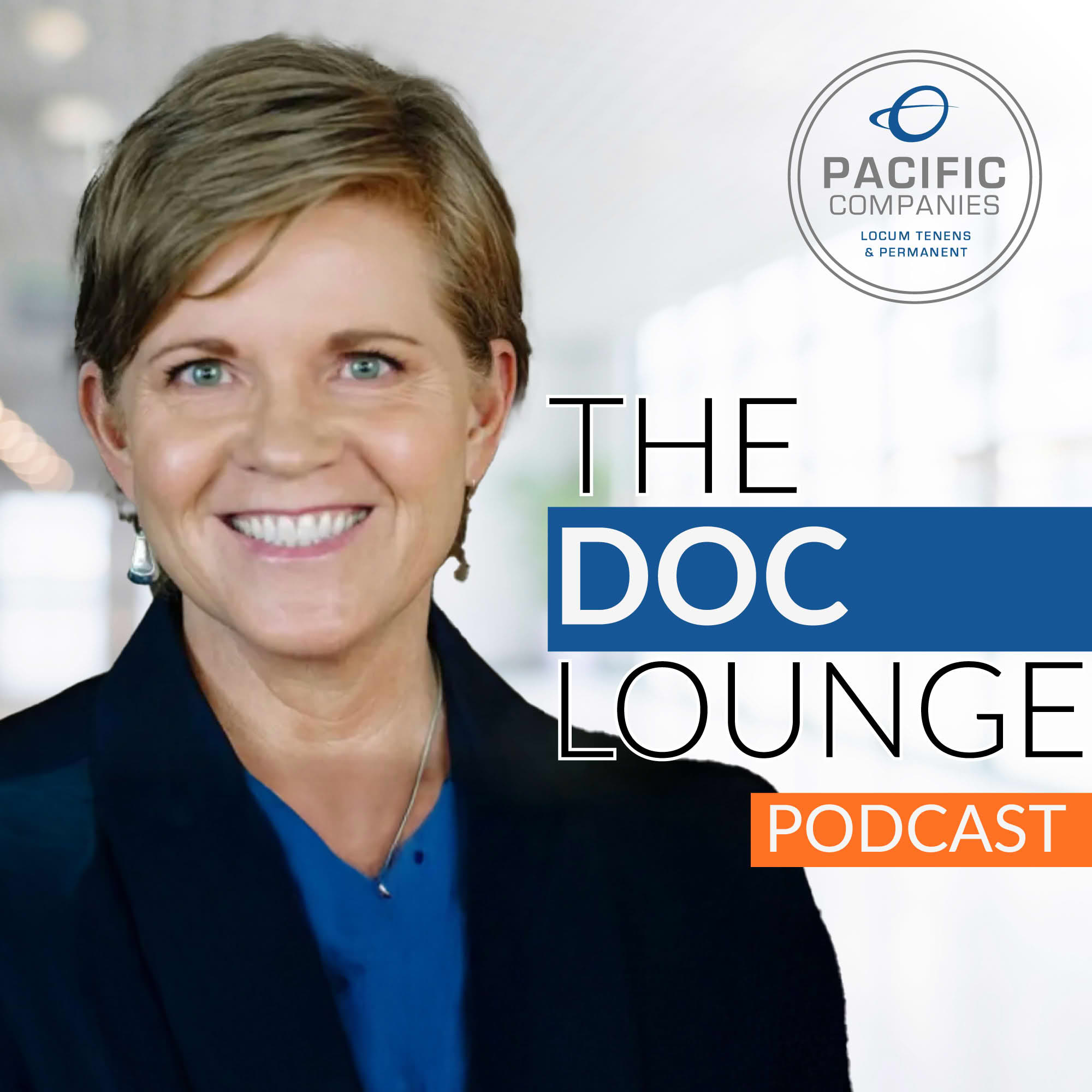
[00:00:19] Speaker B: Welcome back to the Doc Lounge Podcast. I'm your host, Stacey Doyle, Senior director of Marketing at Pacific Companies. And today I'm joined by Dr. Michelle May, a former family physician, associate professor at Arizona State University, and the founder of and my hungry mindful eating programs and training. Dr. May brings both clinical expertise and deeply personal experience to today's conversation. From middle school through medical school, she struggled privately with disordered eating, body image, and repeated dieting. During her medical career, she discovered that many of her patients were experiencing the same difficult relationship with food in their bodies.
She went on to create Am I hungry? Which has trained more than 800 healthcare professionals to offer mindful eating programs. She is also the author of Eat what you love love what you eat book series and has taught a mindful eating Masterclass for the Calm app. Dr. May is also the co author of a scientific review examining the consequences of weight centered health care and presenting a frame framework for more weight inclusive patient care.
Today we're discussing how our diet and weight obsessed culture affects patients, the harm weight stigma can cause in healthcare, and how clinicians can shift the conversation away from body sides and towards sustainable health and well being. So Dr. May, I'm really excited to have you on. Welcome to the Doc Lounge podcast.
[00:01:39] Speaker C: Thanks for having me, Stacy. I'm glad to be here.
[00:01:42] Speaker B: Such an important topic and one that I don't feel like is discussed enough. So really excited to bring this to our audience of fellow physicians and clinicians. So tell us a little bit. I know you described, you know, earlier on you had kind of this struggle with food and body image and then how that kind of shaped your personal experience as you became a physician.
[00:02:07] Speaker C: Yeah, you know, I think it's very common. It was common even way back then and it, I think it's become increasingly common, common especially for women, but men as well, to have body image struggles and that often will start a pattern of restrictive dieting, whatever that looks like for the individual. And of course that's something that has changed many, many times over in, in the last number of decades.
But that pattern of restrictive dieting often leads to other issues that will eventually cause a person to go into overeating cycles as well. In fact, I call it the eat repent repeat cycle. We also call it yo yo dieting weight cycling. And we see this a lot in our practices.
But personally I had struggled with exactly that same challenge since I was 13.
It didn't really have anything to do with why I went into medicine. I probably went into medicine, you know, wanting to help people, sincerely wanting to help people. And, and at the time didn't realize that my own personal struggles would be the way, the pathway for me to help many, many people who weren't getting the help they needed in other places.
[00:03:26] Speaker B: Well, that is inspirational. Obviously you knew that you wanted to help people, that's why you became a provider and then really said, okay, this is something that I know, I know about and I can use obviously all the skills that I learned in medical school to, to help with my patients. Tell us, I mean, how would you describe healthcare? You know, as operating within kind of this very weight centric paradigm. It's typically BMIs, you know, your weight, that type of thing.
[00:03:54] Speaker C: Yeah, that's, that has really been something that many of my patients and people that I've worked with since then have struggled with. Because of course, the minute you walk in, weight is the very first vital sign that's collected, oftentimes in a very public place.
And I think a lot of people experience a lot of shame and concern about that in their medical encounter, which is unfortunate because it puts the physician and the patient from the very beginning in a difficult situation.
The other thing that really happens with this is because the clinicians are really presented with this weight centric approach to health. They will often address most problems in a larger bodied patient as though weight loss will solve all issues.
That's not true.
And of course, many people have problems that thin people get as well. Thin people get diabetes and hypertension and arthritis and other kinds of issues. And so we wouldn't recommend that they lose weight. We would do the appropriate testing or studies, we would refer them to physical therapy, write the appropriate prescription, hopefully have some conversations about how lifestyle might improve their condition. But when it comes to weight, where the culture is so weight centric, that oftentimes that's the first thing and too often the only thing that gets addressed
[00:05:36] Speaker B: that makes a lot of sense now that you're saying it. Obviously it's, you know, when you first get into, you know, and you're going to see your provider, that's the very first thing that they do. And then it seems like it's obviously they're, they're really weighing kind of everything based off of that.
So tell me. I mean. Yeah, yeah, so tell me. I mean, how, what do you think some of the stigma can look like in healthcare settings. You know, it may be more subtle or maybe more overt. But tell us about that. Obviously, you have experience.
[00:06:05] Speaker C: Well, it happens the minute somebody walks in the door. You know, a person in a large body may not have a seat that appears comfortable and safe for them, right when they walk into the waiting room.
They may end up in the exam room getting a blood pressure check when the cuff is too small and misreads their blood pressure, or where the medical assistant says, oh, hang on, this cuff is too small for you. Let me go get a bigger one, and leaves the room, you know, creating this sense of embarrassment and shame. Then you hand them a paper gown that doesn't cover their body and makes them feel exposed and embarrassed and ask them to step on an exam table that may not be stable for a larger body. So in many ways, there is this. This bias that is created in the system, and it. And it causes people to not want to go to the doctor at all. In fact, there have been some really good studies that have shown that, for example, gynecological cancers are diagnosed later in people in larger bodies. And so the assumption might be, well, yeah, people in larger bodies get, you know, gynecological cancers.
Maybe, maybe they're not going in to see their clinician because they're afraid of the encounter. They're concerned about how they'll be treated there. And then a lot of physicians have their own internal bias, their own implicit bias. They don't even realize that they aren't recommending the same studies or treatments for their larger patients.
And maybe creating some of the things that we blame on weight might actually be from withholding appropriate blood pressure medications, for example, until somebody loses weight, which we already know, based on studies that weight loss, particularly behavioral weight loss interventions, aren't very effective and they aren't very sustainable.
Same with medical therapies as well. They're. They're not sustainable without continuing the medication and continuing intensive intervention. So we've created this setup where both the clinician and the patient feel like there's something wrong, but nobody's really putting their finger on what the problem is.
[00:08:44] Speaker B: Well, that is very insightful and very, you know, I think, again, something that haven't heard before. So tell us a little bit. Obviously, many patients spend years losing and regaining weight.
What does the research tell us about weight cycling and its potential physical and emotional consequences?
[00:09:05] Speaker C: Well, for one thing, the fact is that that restrictive eating, restrictive dieting, doesn't work well because our bodies are uniquely designed to produce, prevent us from Starving to death. You know, we evolved over centuries of food scarcity. And so when the body perceives food scarcity, even if it's intentional, that will have negative metabolic effects. People certainly lose weight, but they lose muscle, which is metabolically active, and it ramps down their metabolism.
And similarly, it creates. Creates a whole series of psychological changes.
So the hedonic properties of food, the. The properties of food that make it taste good and smell good become heightened because the body is trying to tell you to eat more. So it is not your imagination that when you go on a diet, it seems like the food you're trying to avoid appears everywhere and seems very hard to resist.
So we set up this way of losing weight that is not sustainable for the vast majority of people.
So they will lose weight initially when they regain weight, which most do. We know this happens over and over. Clinically, we've all seen it time and time again. The tendency is to blame the patient. They're not adhering to the diet.
They haven't found the right diet. They're not being good.
But the truth of the matter is their body has set them up to regain that weight. And when they do, they regain mostly the fat that they lost, not the muscle mass that they lost. And so their metabolism may be permanently lower. And this may be partial. This may partially explain why over time, many people seem to gain more and more weight as they go.
So all that to say that, you know, it's easy to focus on weight and it's easy to focus on weight loss as the solution.
But actually, the research is very much based on correlation, not causation. So we can assume that diseases are caused by weight excess, but in fact, they are correlated.
There has been some studies that have shown that. That weight cycling may be part of what makes people more prone to certain diseases.
Weight stigma and weight bias, as I talked about before, can affect the way a person shows up in. In medical settings, maybe prolong, you know, waiting to go in for symptoms or their clinician. And there's some pretty horrific stories about this, that they went in with a specific complaint, and instead of addressing that complaint, they were advised to lose weight. And by the time they were finally diagnosed with stage four cancer, it was too late. And that, you know, hopefully that doesn't happen very often, but it's. It happens enough that all of us need to be much more aware of our own explicit and implicit bias when we're seeing our patients in larger bodies.
[00:12:23] Speaker B: That is a perfect leeway, because I wanted to ask you, how can clinicians address Some of these concerns that they may have that may or may or not be associated with weight without making their patients feel judged or blamed.
[00:12:39] Speaker C: Without a doubt, many of these conditions at least partially respond to lifestyle changes. So if we can talk about behavioral changes without making the intention weight loss, for example, somebody with, let's say, hypertension or early, maybe, you know, early hypertension, we might talk about beginning an exercise program, we might talk about modifying the diet. We can have those conversations without saying you need to lose weight, because ultimately if the person doesn't lose weight or loses weight and then regains it, they have failed. Whereas if you talk to them about starting a gradual exercise program, that might be something that they can sustain long term without focusing on whether it results in a change in their weight and follow up their blood pressure instead of the number on the scale as one example.
[00:13:44] Speaker B: That's a great, that's a great example because, and that leads because I was going to ask you, so what, in your opinion, what does weight inclusive care look like in practice? Is it, you know, is it simply avoiding some of these conversations or is it, is it bringing it, you know, in a different way?
[00:14:02] Speaker C: I'm trying to avoid it. And the truth of the matter is your patients are bringing it up as often as you are, if not more.
You know, people, we all live in a very weight centric environment. And so your patients are coming in asking for weight loss. That's what they've been taught and told that they should, you know, do. And, and they expect to have miraculous results with that. So it's, it's not about being afraid of it. It's about not centering every conversation around somebody's body size and really having conversations with our thin patients just as we would our larger patients. Because this works both ways. I've had clients of mine who are in smaller bodies who tell me that they have an eating disorder and they were never asked about their eating behaviors. I've had clients who used exercise in a punitive, punishing, restrictive way, and they were applauded for it. And so I think if we can think about asking all of our patients about their, their lifestyle behaviors and then work with them on maybe beginning with one of the simplest ones right up front. How can we, how are you willing to work on, I'll say, your soda intake.
It sounds like you're concerned about how much soda you drink. Is that something that you have wanted to address?
And if they reply affirmatively, okay, so what are you thinking about doing? What would be a realistic way of beginning to Modify that particular choice you're making.
So you see, I, there's a lot of language I'm using that I want to just point out. One is I'm not using language like obese and overweight because those. First of all, the word obese implies that this is automatically a medical condition that has to be addressed. It's a, you know, medical diagnosis. Overweight implies that you are over some specific weight that you should be, when in fact research shows that people, the healthiest people, are in the bmi, which we, that's a whole other discussion we could have, are in a bmi range of 35, 25 to 30.
Those are the ones who live the longest. And so again, those are core. That's correlation. But I think rather than using terms that people have come to feel ashamed about, I think we can talk about medical conditions without always turning it back to BMI or weight.
The other thing that I was showing as I was talking about perhaps these lifestyle changes is not being the expert in the room, but being somewhat of a coach, really guiding people to make decisions for themselves.
You are the expert and you are the one who's going to, you're there. Obviously you don't have a tremendous amount of time with each one of your patients, but having a conversation that opens the door and trusting that over the course of your relationship with that client, that patient, you'll get to build on additional lifestyle changes. You can tell I was a family doc before, before I turned full time to mindful eating.
[00:17:39] Speaker B: Well, I love it. Now tell us about mindful eating. Tell us about this concept. I know you've obviously done a ton of work and helped design this. So tell us about it and help us understand what it can do for us.
[00:17:52] Speaker C: Yeah, sure. Well, so I had, I went into family medicine. I practiced family medicine for about 16 years Al together.
But as you said in my introduction, I did struggle with, with my own eating and body image problems. And when I went into my practice, I kept hearing the same thing from a lot of my patients.
And at first I was sending them to Weight Watchers because that's what I'd done forever. And you know, Weight Watchers is a perfectly good diet, but they weren't really having any better long term success than I had. And that really got me thinking that maybe the whole paradigm was flawed and what we were asking people to do really doesn't work because, gosh, if you can get through medical school, you should be able to stick to a diet permanently. And if it's possible, and it wasn't possible for me.
So the, the process that I developed and I worked with a dietitian and exercise physiologist and a psychologist initially to develop this approach. But it's really based around the idea that restrictive dieting creates more obsession with food, more cravings, willpower runs out, and then we end up in that eat, repent, repeat cycle.
So we used a non diet approach, meaning we're not telling people what they can or can't eat, but instead we're using mindfulness skills to help them become more aware of their own natural internal cues of hunger and satiety, which is something that most of us get completely divorced from. You know, as children we're made to clean our plate, or in medical school we're rushing through a meal or we go on a diet and we're told we're not allowed to eat unless, you know, we, there's been four hours between meals, even if you're hungry, or conversely, that you have to eat every three hours and you know, don't let your metabolism go down. So there's a lot of fear based messaging around eating when in fact, we were all born with the instinctive ability to know when our body needed fuel and to know when we'd had enough fuel. And we've unlearned that. So we use mindfulness skills to help people reengage with their signals of hunger and satiety and similarly to also recognize when they're wanting to use food for other reasons. Environmental cues, social cues, emotional eating and so forth. These other cues that cause people to eat when they aren't hungry or to continue to eat past the point of satiety.
[00:20:38] Speaker B: That's fascinating. And I know you've worked this into your, your book. So tell us about, you know, your book that's available and what you know, anyone reading that can, can expect to learn.
[00:20:52] Speaker C: So the book, it's actually a series of books. The first one was called eat what you love, love what you eat.
And we had so much success, so many people telling us how transformational it was, we adapted it for others as well. So we have eat what you love, love what you eat for diabetes, Eat what you love, love what you eat for students. I teach this class at Arizona State University and we have a workbook for people who've had bariatric surgery and eat what you love, love what you eat for binge eating. So these are all based on the same process, which is a model called the mindful eating cycle where you and your patients can learn how to make mindful Decisions that don't involve willpower and guilt to control yourself. In fact, I say it's not about control at all. It's about learning how to be in charge. Meaning that you're aware of what's happening in that present moment.
You're not judging yourself or thinking you're bad. If you want to eat the, the cookies, there's no problem. Lots of people eat cookies. And when you can do that without guilt, you don't have to eat the whole package because you can have them again whenever you want them again. There's no impetus to finish it off and go back on your diet the next day.
So that mindful eating cycle is a really simple but elegant way to understand the decisions we make around eating and begin to change that decision making process.
[00:22:29] Speaker B: This sounds like really, really important, you know, just a different approach to, to eating and to being, you know, thinking about weight loss. And I mean, right now all we hear about are GLPs and all these things like that.
What do you think? How is that impacting your work and how people are viewing eating and weight loss in general? And where do you kind of see things going? Obviously, because knowing some of those, you have to stay on them for that, for that effect to continue.
[00:23:02] Speaker C: Yeah, yeah. So I'm not in clinical practice anymore, so I'm not in a position to prescribe these to my patients or clients.
I will say that they finally, I've been saying, I've been doing this work since 1999 and I have been saying for literally two and a half decades, diets don't work. Diets don't work. Diets don't work. Finally all of a sudden these come out and everyone's like, well, you know, diets don't work. And I'm like, right, I've been telling you this forever, but until they had something else that, that had an effect, there was no admission that what we had been forcing down people's throats really was not effective. So that has been a positive change.
The negative part about it is that it, like many other past cures or solutions, I won't even name them all.
There is always a period of time when everyone's like, this is it, this is the miracle. This is going to solve the problem. But you've already addressed one of the issues, which is apparently now we don't have the studies for people on it for the rest of their lives. So we don't really know what happens to, to people when they're on it for 40 or 50 years, which presumably is what they're suggesting. And so my concern is that it doesn't really address why people are eating in the first place. And so we may not ever get to a place where we are doing anything more than waiting until people get to a point that they need to start a medication and then putting them on it forever.
That's a bit problematic for me and I, and I feel that although I don't have an easy, easy way to address this, I think that we're going to have to think more deeply about what it is that we're actually recommending because I don't think it's going to be affordable or accessible. And we certainly don't know safety or even effectiveness when people are on this for many, many decades and most people don't. I mean, you know, there are studies showing that well over half the people are off by year two.
So, you know, I think, I think we've got another solution. Solution that may not actually get us where. Where we need to go.
[00:25:35] Speaker B: Very fascinating and I appreciate that because I know that's, you know, top of mind for, for a lot of clinicians out there that are obviously, yeah. Dealing with this day in, day out.
I want to just give you an opportunity to let you know fellow clinicians or any patients that just want to learn more how they can get, you know, best, a hold of your books and any other information about working directly with you. I know you also have a masterclass in the. Com apps. That's really cool.
[00:26:06] Speaker C: Yeah, well, we do. So am I hungry? Is my website amihungry.com and there are loads of free articles and blog posts and things for you and your patients on that site so you can learn more about mindful eating and explore this idea more.
A very simple way to check out the book is to download the first chapter.
And the reason that I do that is that it explains the mindful eating cycle and it very quickly will give you and your patient a way to say, is this for me? Does this make sense to me?
So it's, it's ami hungry.com sl chapter one chapter spelled out and the number one. And I'll send that to you so you can include it in the notes, but you can download it for free and see whether it makes sense to you in terms of whether this might be a new way of looking at these eating decisions that you're making.
We do train clinicians as well to offer programs and coaching and therapy and, and other things, so you'll find that on the website too.
[00:27:16] Speaker B: Fantastic. Sounds like valuable. Resources. And this has been a very, very enlightening conversation about something that I don't think is talked about enough. So I want to thank you, Dr. May, for coming on, bringing awareness to this issue and having a great, you know, practical resource that everybody can utilize to help them with, with the way that they're thinking about eating. So thank you so much.
[00:27:39] Speaker C: You're welcome. And I forgot to mention, I do have a the clinical paper that you mentioned at the beginning. I'll be happy to send that abstract to you. And we produced a one page document to how how clinicians in a clinical setting can reduce weight bias and a weight centric approach. And so I'll send that to you as well in case people are interested in learning how to do this in their practices.
[00:28:06] Speaker B: That's fabulous. We will share that with our audience and post that as well. So thank you so much, doctor Mate. Really appreciate it.
[00:28:13] Speaker C: Thank you.
[00:28:15] Speaker A: Thank you to all of our listeners. If you would like to be notified when new episodes air, make sure to hit that subscribe button. And a big thank you to Pacific Companies. Without you guys, this podcast would not be possible.
If you would like to be a guest, Please go to www.pacificcompanies.com. thank.
You.