Episode Transcript
[00:00:01] Speaker A: You're listening to the Doc Lounge Podcast. This is a place for candid conversations with the healthcare industry's top physicians, executives, and thought leaders.
This podcast is made possible by Pacific Companies, your trusted advisor in physician recruitment.
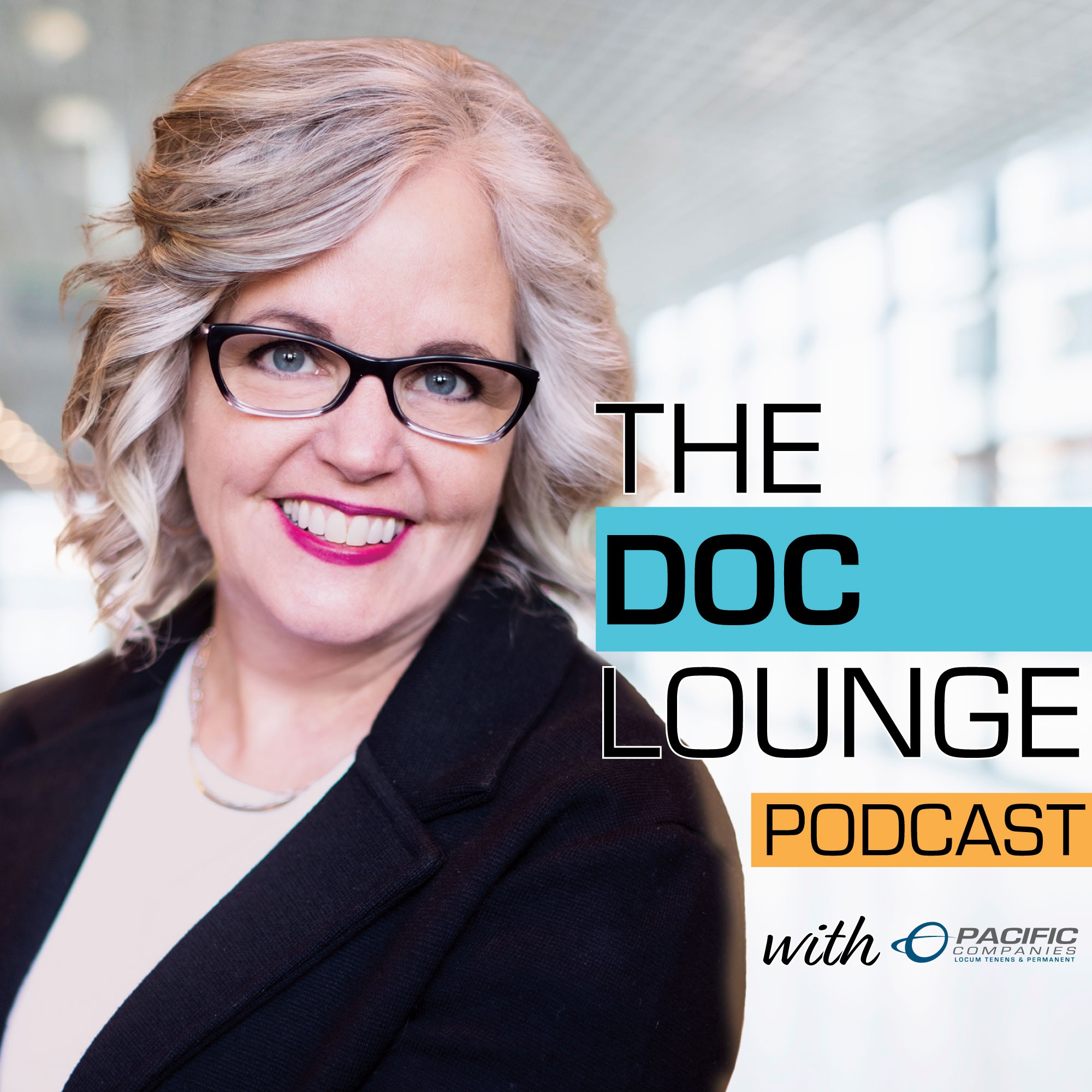
[00:00:20] Speaker B: Welcome back to the Doc Lounge Podcast. I'm your host, Stacey Doyle, senior director of marketing at Pacific Companies.
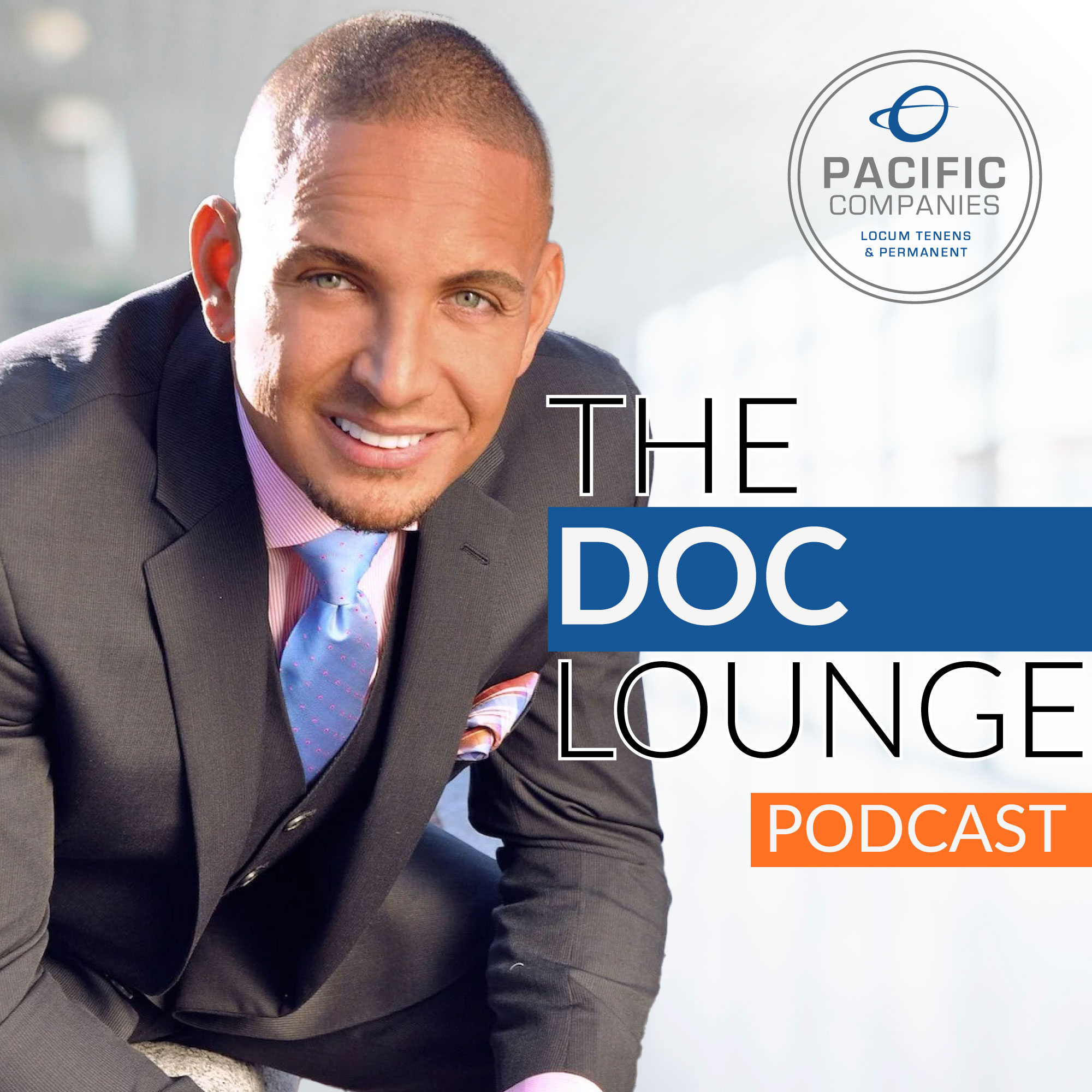
And today we're diving into a conversation that truly hits at the heart of what so many in healthcare and beyond are facing. Mental health, stress, and the power of breath. Our guest, Curtis Lee Thomas, is the founder of the Just Breathe foundation, an organization featured on the Today show and voted the number one employee wellbeing provider of 2023. Curtis has worked with companies like Nike, NASA, professional athletes, and celebrities to help people overcome anxiety, trauma, stress, and ADHD through his transformational breathwork method. After just one session, 98% of participants report major stress relief, improved focus, and deep relaxation. Which explains why Curtis was named 2024 Entrepreneur of the Year by Best Holistic Life magazine. Today, we'll talk about his mission to make mental health support more accessible, how breathwork can help healthcare professionals manage burnout, and why this simple, natural practice is transforming lives across the world. So take a deep breath, settle in, and let's get started. Welcome to the podcast, Curtis.
[00:01:35] Speaker C: Nice. Thanks for having me. I appreciate it.
[00:01:38] Speaker B: Well, I'm so excited to have you on today. This is such an important topic for our audience and something we've covered before.
Burnout, you know, of all of the amazing work that our providers and clinicians, you know, are doing on a daily basis with. With their patients. So I just want to let our audience get a little bit familiar with you and your work.
Can you start by just sharing what led you to create your Just Breathe Foundation?
[00:02:07] Speaker C: Yeah, well, what led me to, I guess, breath work in general, you know, let's say, was I actually had a rare stomach condition and doctors couldn't diagnose me, never mind heal me. So through that suffering, I became very desperate, you know, searching, you know, all different types of modalities that are out there, which eventually led me to breath work, where I had a profound experience.
And I was already venturing, you know, very desperate into plant medicines and, you know, whatever would help heal me. And one session of this particular technique completely eradicated my stomach condition.
And, you know, I am very skeptical person by nature, very analytical, very logical. So I'm like, how is this possible?
And. And I realized, you know, the reason why, you know, all these doctors couldn't help me or fix me. And I was going to some of the best doctors from New York to LA is because my issue wasn't physical, it was energetic, it was emotional.
And that's when the moment I realized, wow, like, all five years of those suffering boiled down to something that no doctor would ever diagnose me with, which is energy clots. And, you know, even science says humans are made up of more energy than we are, mata. But we don't really aren't educated that much on, you know, the energy within the body. And that's when I found breath work. And that's when I created the breath work detox modality, when I created the Just Breathe Foundation. And the Just Breathe foundation helps extend it to children. We wrote a children's book that we donate to elementary schools. So we're just trying to help as many people as we possibly can.
[00:03:45] Speaker B: Well, I love your mission, and I'm sure this is a very rewarding one for you after, you know, like, what you're saying, your journey, and kind of realizing, okay, I can help heal myself through just kind of this practice. So tell us, I know you've said that the breath is the remote control for the mind. What do you mean by that?
[00:04:06] Speaker C: Yeah. So, you know, the brain's an interesting thing, and thoughts are very interesting, too, because even science today has no idea where thoughts come from. They just know the cerebral portion of the brain where thoughts are interpreted. And we have an average 45 to 50,000 thoughts per day.
And most of those thoughts, 80% of them, are negative in nature and 20% are positive. But even more scary is that 98% of the thoughts that we had today are the same thoughts we had the day before.
So most of us are stuck on this hamster wheel recycling these crappy thoughts. And that's because they say that neurons that fire together, why together?
So the brain will always go into the path of least resistance by default and will continuously have those crappy thoughts. So we need to find a way to break up those neural pathways and create new connection, healthier thoughts. And it's hard to outsmart the mind and beat the mind with the mind.
So if you learn how to beat the mind with the body, that's the cheat code. And being aware of your breath is a lot easier than being aware of your 50,000 thoughts that you have running around crazy like wild animals or like, you know, kids in the school teachers in. So, yeah, the breath helps you just really kind of get present because, you know, the soul always wants to be present. The mind just always wants to live into the future.
But the body holds on to the past.
So the breath helps you release things that you've been holding onto unbeknownst to your conscious mind.
[00:05:36] Speaker B: Well, that is very insightful. So tell us. I want to give some kind of tips from you to, you know, any of our healthcare professionals, you know, that are listening.
What, how do you approach this? What, what would you say that they can start doing to, to work this into their daily routine?
[00:05:56] Speaker C: Yeah. So first of all, breath work, what I teach is an umbrella term, right? So it's kind of like yoga. There's many forms of yoga, hot yoga, power yoga, yin yoga, there's many different breathing techniques and different techniques are used for different things.
So we change all of them in our training. The main one that I work with is breathwork Detox. That is a deep diaphragmatic breathing technique. It's the most somatic and cathartic technique out there. But if you want to start simple, I think one of the most underrated breathing techniques is the sigh.
And you know, if you look at the sigh, it is the body's natural response to relieving stress, tension and pain from the body. So if I was sitting in, I was stressed and I was worried and it was building and building and building. All of a sudden it hit that point where my body would go, I let out a sigh of relief.
And that's what the body does. Now the breathwork detox technique is done through the mouth.
And 99.9% of the time you should be breathing through your nose.
But you can't achieve the level of release by nose breathing. It's the mouth is an energetic exodus point. So when you do a sigh, you don't side through your nose. Yeah, you side through your mouth. So mouth breathing is always going to release the energy. And the nose breathing is more connected to the parasympathetic to get you, you know, back into your rest and digest. But a lot of people need a, a deep clean, I call it, right? To get all the junk and gunk from all the heartbreaks, the divorces, the business failures, like whatever it.
And I try to use the analogy of looking at your. Say your car's dirty, whether you know it or not, you got to clean your car.
And if it hasn't been cleaned in a long time, you got to clean your car with a power washer. And that's breath work. Now if you try to clean your car with a toothbrush, it's going to be a lot difficult. And the toothbrush is meditation and things like yoga, which are great you know, I love those things, but they take a lot of time to see results.
And the fact is, we live in a microwave society where people want to see results and they want to see them fast.
And most of the time that's unattainable. Right. You don't go to the gym and then you work out and get a six pack in the morning. I wish.
So, unlike yoga and meditation, the results of breath work are immediate and undeniable from just one session. And I think that's why people love it and why the popularity is exploding.
[00:08:26] Speaker B: I know that you also work with a lot of people struggling with, you know, anxiety, adhd, you know, chronic stress. So what makes this more effective, do you think, than kind of some of the traditional approaches? You know, maybe medicine that, that has been prescribed for the.
[00:08:44] Speaker C: Well, first of all, the breath will work faster than any pill you could ever swallow, you know, but by the time it goes down, your throat, goes through this, you know, the stomach, small intestine, you know, so it's a great tool to get people. Now, I will say I am not one of those people who's totally against western medicine. I'm not. All right, I got cavity giving the Novocaine, I break a bone, give me the painkiller. Like, I am not. I. I think the future is where the two worlds merge.
[00:09:09] Speaker B: Right.
[00:09:10] Speaker C: And there's a gap that's bridged between those two because there's a lot of things that each one of them don't know.
So, yeah, I think the merging of the two is the future. But what was the question? I want to go back to make sure I answer that.
[00:09:23] Speaker B: Well, I think, I think you answered it. I. I'm saying for those, you know, people with. Struggling with those conditions.
Yeah, you think that this is because it's that immediate impact, like you're saying that they can then and then do that on a daily basis.
[00:09:38] Speaker C: Yeah, everyone's struggling with something, you know, some. A lot of people wouldn't. They're not willing to talk about with anybody. And, you know, I've seen what you could call miracles happen. You know, me being one of them with this particular practice, because it gives you exactly what you need. And we just hold on to so much, you know, emotions and, you know, everyone's stressed. Like Harvard did a study and they said that 80% of all doctor's visits are stress related.
So think about that number. That is astronomical number.
And so there's no other natural organic modality that's faster and more effective for eradicating stress. From the body than deep diaphragmatic breath work. It's not out there. I've been searching for the past decade and a half, and, you know, I started off as a certified life coach, NLP practitioner, hypnotherapist, Reiki master. I went to the jungle. You know, I did everything, all this stuff. And, you know, besides medications and pills, it. It relieves, like, think about that. Sigh. What that does is it releases the tension. But in this particular modality, we continuously do that for about 28 to 30 minutes, and you start to peel back the layer, the layers. It's not just stress, right? Then it's accumulated stress, and then it's chronic stress. And then it's, you know, unresolved emotions and trauma. And this is why 50 to 60% of the people end up crying during their sessions and has nothing to do with weakness or masculinity. Because I've taught breath work for some of the most masculine men on the planet, from war veterans, Navy Seals, you know, NFL athletes. And they all cry, and they're like, why am I crying? And it's because the body is a living library of all of our past experiences, and the issues are in the tissues. And this is what I discovered through my painting, Suffering. And this is what I'm looking to share with people.
[00:11:38] Speaker B: I know you've worked with some incredible organizations, from Nike to NASA. You said professional athletes, I'm assuming, obviously, you know, doctors, nurses.
How do you adapt for different groups when you're. When you're speaking with them?
[00:11:56] Speaker C: Yeah, great question.
You know, I try to be me and just be relatable. You know, people just want people who they can understand. I don't go up there, try to sound smart. I just try to give it to them as real as I possibly can. I do make it entertaining and fun, and I think that's, you know, what makes it cool. Right. Healing doesn't have to be boring. And, you know, you go in, you have to do these mantras and humming, you know, and the low meditation music. Like we use, like, you know, music. And it's. It's live and it's fun and it's engaging, and I feel like that's what the world needs right now. So, yeah, it's. It's more of an experience.
[00:12:36] Speaker B: Well, I feel like an experience is what people, you know, are seeking and really kind of having a. A way to change their life and kind of something they can do on a routine and. And make it, you know, something that's really impactful, that they can Start weaving into their lifestyle. So I can you just walk us through like what would actually happen during a breath work session with you? Yeah. And that can give people some ideas of what they can, you know, learn.
[00:13:06] Speaker C: Here's the beauty of it. There's no barriers to entry. And with a lot of mindfulness modalities, what companies will do, they'll throw in yoga and meditation because that's all they know.
And you know, but if you look at yoga, first of all, 54% of the world's population can't bend down and touch their toes. A huge percentage have body shaming issues. Another percentage has performance anxiety. You know, you don't want to go into a yoga class with people who've been doing it for 20, 30 years and you're the newbie, you know, can barely like do the poses, you know, even meditation. I think the study came out. Goldfish has a more of attention span than a human being does.
And you know, it's, it's funny, but it's actually one of those things I googled. I'm like, wow, this is actually true. But if you take somebody who's stressed out, which is pretty much everybody, and you say, sit down, sit still and don't think a thought for the next 20 minutes, they're going to get more stressed out.
And the great thing about yoga, you could be £400, fully clothed, just lay down on your back and breathe and do this particular technique for a specific amount of time. And you may just have one of the most profound life changing experiences that you've ever had. And you know, to be a little bit more technical logistical is it's a three part breath. So it's two breaths in, one breath out. So the first breath goes deep into the belly. So I usually have people put a hand in their belly and a hand on the chest. First breath goes 80% in the belly and then 20 in the chest and then you just release and let go. As soon as you let that go, you go right back into the next one. But you need to make sure to breathe deep down into the belly for that diaphragmatic breathing because that offsets the stress trigger of hyperventilation. Because people think we're hyperventilating, we're not. So deep into the belly, fill up the chest, let it go. And you continuously do that and you're flooding your system with the most vital life force nutrient on the planet, which is oxygen.
[00:14:53] Speaker B: There's growing evidence behind breathwork's impact on the nervous system and trauma release. So I wanted to hear what you think, you know, and how your practice fits in, you know, with this, like you were saying earlier, this blend of mainstream medicine and kind of this future state of mental health care.
[00:15:16] Speaker C: Yeah, I. I think, you know, everyone in their life, they. They want something, right? They look into whether it's manifest something in their life, whatever. But I realized we. We actually don't need to let in. We need to learn. Learn to let go. You need to let go before you can let in. So, so many people are just holding on to so much. And the irony behind it is that you actually don't know how much you're carrying until you release it.
And that's the beauty of it, because you're like, oh, my God, I had no idea I was carrying all that. Now people, they're walking away lighter, they're walking away brighter, more buoyant, happier.
And there's just not too many things out there, you know, without taking drugs or some sort of pill that can give you that. So this is why I'm so passionate about this. And, you know, I've done this. And I know it's really hard for somebody who maybe went to a breathing class or, you know, yoga class doesn't understand what I'm talking about. And I understand that because what I tell people is trying to describe breath work is like trying to describe a kaleidoscope to a blind person.
Like, it's impossible. It's something that cannot be explained. It can only be experienced. And it's so unassuming. It's something we do every single day. But when people do it, it blows their mind. Like, I remember when I first learned this, I started, I was living in la, so everyone's a yoga teacher. And I was. I said, a couple yogis. I said, hey, I want to show you this technique that I learned. And like, oh, I've done pranayama. I went to India and Rishikesh. I studied with this guru. I've been doing this for 20 years, certified in yoga. And I'm like, just try it with me. And then they do it with me. And they're like, holy crap. I had no idea that existed. Where you learn this. Can you certify? So I started certifying yoga teachers in this modality. And even Dr. I say, Jack, Dr. Jack Kingfield, but it's not Dr. Jack K. Dr. Jack Feldman, who's just on the Huberman podcast, and he's one of the top neuroscientist in ucla. And he's been doing this way longer than I've been doing this and he actually came to one of my breathworks and completely blew him away. And then we started working together and we went into NASA together and we showed them the technique. And yeah, it's just, this is mind boggling that people don't know this exists.
[00:17:36] Speaker B: That's so, that's so neat that you, you know, you guys collaborated and. Yeah, I, then the NASA piece is, is really, really extraordinary. So I'm sure you've, you feel like, oh, wow, you've accomplished so much because you've, you know, you're meeting with all these people and making impacts to so many people's lives. What, what do you think is next for you and the Just Breathe Foundation? What, what are you hoping to accomplish moving forward?
[00:18:01] Speaker C: We're working on a docu series now to really showcase this and going back to the, the ancient origins of the breath and showing all the facets of it, you know, from, you know, deep in Tibet, you know, in India, and even how the breath is weaved throughout all religions. And then also the modern breathwork. Boom, that's happening. I really want to showcase that and I think that's going to be the next big project that's going to come out.
[00:18:28] Speaker B: Oh, that sounds really, really fascinating. Well, we'll, we'll keep our audience, you know, tuned in whenever, whenever that comes out. So let us know and tell us, you know, how can, if anyone's listening that and they want to obviously, you know, get involved and take one of your, your classes or workshops. How can they do that?
[00:18:48] Speaker C: Yes. So besides training people in this modality, I do virtual sessions anywhere from once to twice a month, which is really cool because people can do this in the comfort of their own home and people log on from all up, all over. We're up to like 27 countries right now. And they can just go to breathworkdetox.com just type in breathworkdetox.com and then you'll see a little program suite, virtual event, teacher training, corporate and whatnot. So if you go to the virtual event every two weeks, we have one that they can log in and they can, they can try it.
[00:19:18] Speaker B: All right, well, thank, thank you. That's an amazing resource. We'll definitely share that with, with our audience so that they can take it, take advantage of that. That's, that's amazing.
Tell us, Leave us with a final tip for, you know, any, any physician or clinician that's listening.
How can they work in. When would you recommend that they work in some of these Breathing exercises with a day of practicing or a day of being in the hospital or the day, you know, day in the clinic.
[00:19:48] Speaker C: Yeah, I mean, I would try, if I were them, I would make a small commitment to adopt a breathing technique into their life because once they start seeing the benefits of themselves, they're naturally going to pass that on to everyone they love, including their patients. Now, you know, I love doing, showing them the breath work detox at first because it's the most powerful. And what I feel that does is it once you do it, it just opens up your mind and you're like, wow, I didn't know my body could feel like that naturally just from breathing. And what it does is it gets you really curious of what other techniques are out there that I could implement. Because not the, the other techniques don't offer such a, you know, radical results in that short amount of time. But there's box breathing, which is great. I do that every day. 4, 7, 8 method, which is great. Those are the basic ones that if you can just do those. And I said small commitment because this is much easier than saying, I'm going to start a yoga practice. I'm going to start going to the gym, or even meditation. Meditation. You got to sit down for 20 minutes and don't do anything. If you implement a breathing technique every day, you only got to do it for two or three minutes a day.
That's a very short commitment. And when you start doing that in a short amount of time, even if it's not one of the most powerful ones is breathwork Detox. You will start to see a new regulation in your nervous system and just, you know, things that bothered you before all of a sudden, they just don't bother you. You know, it's just like little things like that and you're like, oh, wow, this is actually. And then they become the advocates. Makes my job easier.
[00:21:26] Speaker B: We love that. Well, well, thank you so much, Curtis. Great, great, you know, insights and, and tips about how everyone can really start adopting, you know, the breathwork techniques into their daily routine. And I really, I commend you for spreading, you know, your word and getting your mission out there. And we'll share all this information so that, that our, our audience can take advantage of all the great virtual events you're going to be hosting.
[00:21:55] Speaker C: Oh, thank you so much for having me and thank you for that.
[00:21:58] Speaker A: Thank you to all of our listeners. If you would like to be notified when new episodes air, make sure to hit that subscribe button. And a big thank you to Pacific companies. Without you guys, this podcast would not be possible.
If you would like to be a guest, Please go to www.pacificcompanies.com.
[00:22:16] Speaker B: Thank.
[00:22:23] Speaker C: You.